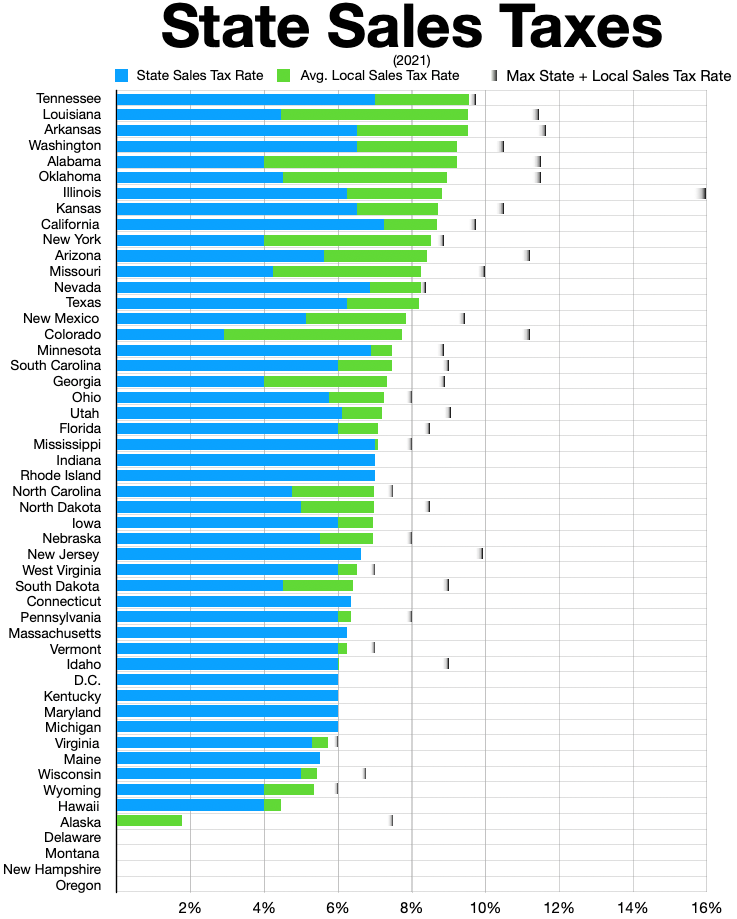
No; in fact sales tax is what’s shifting the burden in that direction. Income tax on the other hand is a progressive tax that keeps impact more proportional.
If you have the resources to declare residency in Texas and pay sales taxes from Oregon you are able to avoid paying most taxes.
I am saying that most people don't have the resources to play tax arbitrage. Those that do are the ones that should likely be paying the most taxes.
Going to a system were sales taxes go to 0 based on where you buy it (online in Oregon) doesn't mean that states will abandon the sales tax but rather that the tax burden that local governments can collect (sales, property) will go up and disproportionately impact the people who can least afford it.
Sales tax is regressive and a worse option for taxation. It is, however, one of the few options that local governments have for raising funds.
The tax system needs an overhaul (though frankly my confidence in congress not just doing another tax cut for the rich is low). Disrupting sales tax without a corresponding overhaul would likely make things much worse in many of the poorer areas of the nation and those where much of the economy is based on non-residents visiting.
Interesting point; yeah, I agree that a significant population does not have the ability to move around. If I understand you correctly, you’re saying that in a world where all sales tax is zero, the wealthier population will be able to arbitrage/optimize over the remaining tax types they pay more easily than those less wealthy, resulting in a larger wealth gap. This argument could also apply inductively in a sense over those remaining types as well, since the optimization problem gets easier as we have fewer dimensions of tax types to worry about. What I’m thinking then is the improvement here isn’t to remove taxes entirely but to remove flat taxes like sales tax and replace them with more/varying progressive taxes that make arbitrage difficult?
I hope I’m not coming off as rude—really appreciate the discussion thus far!
Also consider things like Nevada which has no income tax and one of the higher combined sales tax because they are able to extract money from out of state people as tourists there.
California also shows up in the "rather high combined sales tax" in part because local governments arne't able to reliably use property tax (yes, its another regressive tax - and California is a special case there) to raise local funds. ( https://www.lao.ca.gov/reports/2015/finance/sales-tax/unders... ).
There are some progressiveish aspects to sales tax as it selects which items are taxable. In Minnesota (for example), clothing is not taxed. On the other hand, from Wisconsin, its sometimes cheaper to shop online and have Ikea delivered rather than go to Chicago and pay local taxes there ( https://upload.wikimedia.org/wikipedia/commons/a/ae/State_Sa... )
In many cases, sales taxes try to tax the more "luxury" items though it gets complicated (food eaten in the place of purchase gets taxed while food that is not hot and to be consumed elsewhere is not taxed).
This comes from experience working in the tax part of point of sales software a few years ago. The "it gets complicated" gets really complicated... and even worse when you then start looking at it from the fiscal policy side for local governments.