Haven't read the book, but for those who don't know who Zeihan is, his work follows two threads of post-WWII history:
1. Deglobalization; and
2. Depopulation
The article focuses mostly on deglobalization, but depopulation is in the horse pulling the cart.
Many are familiar with the deglobalization idea from the last US presidential administration. The current administration kept those tariffs, and abided by the previous commitment to exit Afghanistan. Zeihan argues that this trend toward increasing isolationism goes back decades.
What may seem less familiar is the demographic implosion the entire world is undergoing - a baby bust. The vast majority of major countries with the exception of the US and Mexico have passed a point of no return demographically. Their populations will shrink with mathematical certainty. As their populations ebb, so will their economic growth prospects and place on the world stage. The problem is especially pronounced in Asia and Europe, but can be found everywhere.
The reason for the bust: people moved to cities. On a farm, kids are free labor. In a city, kids are expensive conversational pieces.
> Their populations will shrink with mathematical certainty.
Yeah you know why? Because both parents sitting in offices 8 hours a day have no means of looking after their kids. And a mother giving birth needs to return to work in a few months time, else she there's no pay. Oh and neither parent can give up work to raise these future adults because living expenses are too high. I don't know why everyone is so surprised by the raging population decline. Most of the western world is not child friendly, simple as that.
This is a popular theory on reddit, but it's not true. Birth rates are extremely low even in countries that paid parents to stay at home with kids and generally have good work culture.
You would also expect birth rates to be lowest among people working 2-3 low-wage jobs, which is also not true.
As financial stability and safety increase, birth rates go down. That's the only common driver of it.
Historically, children were sources of unpaid labor. They worked (either at the family business or outside the job), raised younger siblings, and took care of elderly parents.
In short, children were (and sometimes are) a social safety net. What happens in societies that try to eliminate poverty, take care of the elderly, and ban child labor? A lower birth rate.
Low birth rates are not a problem (and reflect enormous amounts of social progress). We just need to solve the Ponzi scheme of retirement and elder care, which I think is doable with automation.
> Birth rates are extremely low even in countries that paid parents to stay at home with kids and generally have good work culture.
I'll still bet that there's a significant career opportunity cost to leaving the workforce for a while like that.
> You would also expect birth rates to be lowest among people working 2-3 low-wage jobs, which is also not true.
If anything, aren't these the people for whom the opportunity cost is lowest? A gap on your "resume" after "McDonald's fry cook" to care for your kids doesn't require much explanation when you later apply for "Starbucks barista". If on the other hand you're a lawyer, maybe you didn't make Partner.
> In short, children were (and sometimes are) a social safety net.
I agree with this, and think it applies not just to children, but also to many adults, who can be helpful to their families but who might be unemployable in the larger market. The destruction of family businesses and informal employment is a problem, because society turns into, "get a job with formal compensation from one of these ten monopolies, or else you are worthless". And there are a lot of people who can't meet that standard.
For example, say your family member has mental illness that makes it hard for him to keep a job. If you owned a farm, you could still find something useful for him to do, and put up with him, and he'd be able to earn his keep, more or less.
Or say you meet a woman who, though creative and intelligent in many ways, also has unrealistic ideas about her "career", and who has never really had a proper job. So she's never going to make money, but she naturally tends to the house and does some cooking and contributes to the social life of the people around her. And say she wants to marry you. Do you do it? In a world of small family businesses, surely she'd help out somehow. In a world of FAANG-employed DINKs, she's worthless. And if she insists on living in California? "Sorry, I can't do this single-handed."
What this whole structure of society forces on people is cruelty. "Can you make money or can you not?" becomes the only important question to ask about another human being. It's horrible. At some level, Jeff Bezos' calculations of human worth enter our own calculations.
I'm not at all sure that the subjection of all things to the market has been progress. A world in which more "wealth" was in social/family networks, and where not all labor were so formal, might be a better one.
I'm dating right now, and it's almost always one of the first things asked. Tinder let's you stick that info up front so people can filter appropriately.
Edit: Just double checked, occupation data is right below your name and age.
Although people use much more flowery language then what you use.
"What do you do for a living?" And so on.
Wish me luck finding someone to split rent with. Peace y'all.
Endless (population) growth might not be sustainable, but
> Low birth rates are not a problem (and reflect enormous amounts of social progress). We just need to solve the Ponzi scheme of retirement and elder care, which I think is doable with automation.
… neither is endless shrinkage, automation or not.
Resulting from otherwise positive changes doesn't mean low birth rates aren't a problem. It's a long term one, of course, but they have to be fixed at some point. If the entire world gets to the development level of South Korea with birth rates below 1, civilization will collapse until it regresses to a point that people start having >2 children again.
Social security (in the US) is explicitly designed such that each generation is paying for the one that came before it and generally needs to be larger.
Pensions could and should work just as long as the funds grow faster than inflation, although in practice they can also indirectly rely on younger people paying for older people.
Birth rates are collapsing in rural India as well. Even where women have an extremely low participation rate in the labor force.
I don’t think the issue is simply “cities have less space, working couples have less money”. Its likely more complicated than that, because nothing really explains why people in India’s vast rural areas would have so few kids.
India has issues with traditional farming being uncompetitive, highlighted by infamous farmer suicides. Pesticides were commonly fingerpointed in the past with simplistic "Monsanto responsible for all bad" narratives, but they didn't stop to think. Not using their products would leave the farmers even worse off economically. Better yield is why they pay.
Kids aren't valued anymore economically. Parents will spend a lot but kids aren't seen as a literal asset but as a sacrifice. Altogether it suggests that at some point if governments want more reproduction they will have to subsidize it more strange as it sounds. It hasn't been a problem in the past from growing poorer undeveloped regions but eventually we could run out of people to uplift economically, leaving even the most xenophilic to have to breed more as immigration numbers wind up low. That scenario probably won't come to pass this century, but potentially the next or later.
Nah. EU is "the west" too, and it's more people than US. And maternity leaves here are around 6-12 months. Population still decreases. Significant part of EU was under communism and had baby booms then despite abysmal pay and much WORSE standards of living then than now. Now their populations go down despite the face they are much wealthier and well off. I live in Poland. There's no comparison, when I look at photos and videos made in 80s in my country it looks like 3rd world. I haven't realized then but now when I look back it's crazy how much changed. But people had kids then and don't have kids now.
What changed is perspectives. In communism you'd earn almost the same no matter where, how much, and how well you worked. And money mattered little anyway, you couldn't buy anything with them, you had to have connections to "arrange" anything (even basic building materials were "arranged" through social networks not bought from a shop). So people invested in families and big social networks to survive. And had lots of kids cause there wasn't much else to do. No career to sacrifice, no recreation other than drinking and partying. No internet. TV had 2 channels and most people had only black-and-white receivers. Culture was only accessible in big cities. Half the families had no car. You couldn't travel abroad easily. There was censorship. There were blackouts at the night.
Why not have kids in these circumstances? What are you losing?
Now your standard of living depends mostly on your education and working ethic. And it can vary greatly. Sky is the limit. You can have a yacht. You can travel all over the world. You can be unemployed and live under the bridge. And anything in between.
You don't need other people to survive. Money are very important. Career is an option. There's LOTS of ways to spend time and money. Having a kid is a big sacrifice in this world. So people work more and have smaller families.
The parts of each country that are less wealthy are usually also the parts with highest natural growth.
Basically - economic growth and development reduces natural growth. Pro-family laws are nice, but they don't change the basic calculation of pros vs cons as much as the changes in societies did.
Go back and read Adam Smith. The thing we don't appreciate today is that having more children used to be an investment -- not just in the idea of family, but literally an investment, as kids would grow up enough to start producing more resources than they cost pretty quickly, and were a net contributor to the family.
Nowadays, having kids is wonderful and great and fulfilling and life-changing and all those things -- but economically a disaster.
It is therefore unsurprising that there are so many fewer children. You have to really want them.
Oh, for sure, having children stopped being net-economically-positive long ago -- though the degree to which it is net-economically-negative seems like it has kept increasing, as our expectations of an acceptable childhood keep growing.
I don't think going from 2.x kids per family to 1.x or even lower was mostly about money. It's about opportunity costs (and the resource that you must allocate between the alternatives is mostly time).
To put it differently: in 80s your standard of living was X no matter if you had kids.
Now if you have kids it's 2X and if you don't it's 5X (assuming the same effort).
That's why giving people with kids enough money to survive don't help much. It changes it from 2X vs 5X to 2.1X vs 5X. Maybe 3X vs 5X if you're very generous.
This is really about economics. 100 years ago, having a kid produced more resources. 40 years ago, it was relatively close to neutral ("X no matter if you had kids"). Now, it's super strongly negative.
If that was the case - big social spending would increase natural growth significantly. But it doesn't.
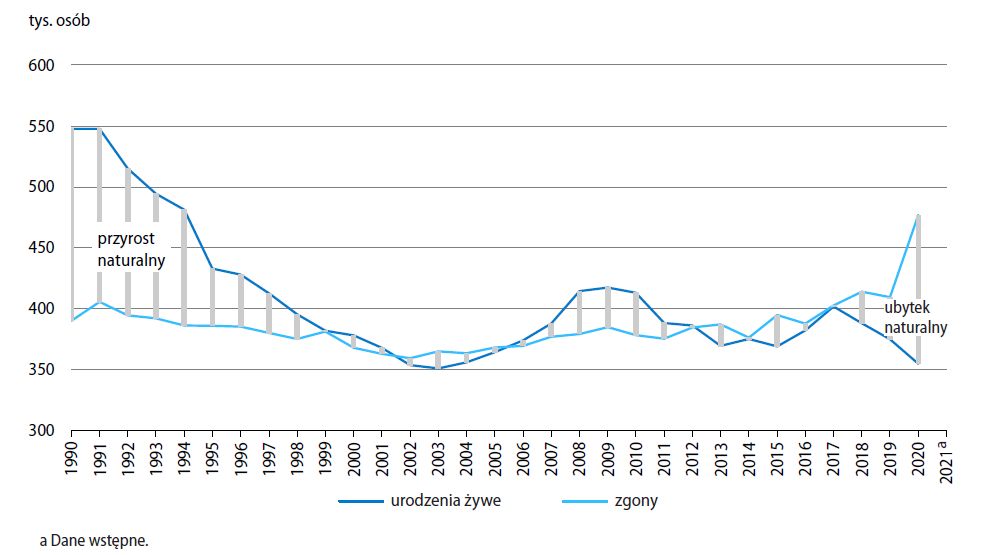
For example in Poland in 2015 a new social program was introduced. Parents get paid 500 PLN for each kid each month till it's 18 years old. At the time the median wage was under 2500 PLN for comparison. So 2 kids increased your earnings by 20%-40% (depending if both parents work).
Natural growth increased by 3.5% for 1 year and quickly returned to the trend. You can't even guess on the graph when it was introduced [1]
Our paper economies are not in tune with reality. They were made to serve people. If there are fewer people with fewer relationships and our economies value numbers over creating happy families, our metrics and economies are broken.
It did not take material wealth or years of checkbox regulated planning to raise a happy family in the past and it does not take it now.
The decline in birthrates is a world wide values and time allocation problem. We do not prioritize relationships and community building, we prioritize immediate gratification and status seeking.
All that an economy should do is manage the logistics of a higher purpose.
But working in the fields doing manual labor is what makes population explosions. It is crassly more a matter of economics. Kids are liabilities in urban and highly educated sections and an asset in rural manual labor situations. Urban vs rural has basically always seen that through different means.
Even if we fixed those problems, birth rates would still be falling. Why? Even accounting for social changes like the sexual revolution, researchers have found that birth rates would still fall due to decreasing male fertility which is common in any industrialized country even for developing ones now, which is alarming. (Everyone has good theories, but no one knows definitively why it is happening.) The only continent that still has healthy fertility is Africa, and that’s only for central Africa. Even coastal Africa is starting to be affected by this Children of Men phenomena.
Need I remind you women are creatures with their own volition and needs, who may decide for or against going to work -- and derive satisfaction or frustration from it -- just like men?
You could make the more reasonable argument that it's increasingly unreasonable to expect any person of any sex to sit in an office for 8 hours a day. And that's not even to mention people doing real, physically extenuating work for really long hours (which those of us on HN tend to forget about, comfy in our white collar bubbles).
Its alarming how fast all earlier projections are being proven wrong.
Like in India, our latest survey revealed that our fertility rate is now already below replacement level - a landmark we were supposed to hit in 2050. We hit that three decades ahead of schedule.
Sub-Saharan Africa is irrelevant, economically. Majority of the population engages in subsistence-level agriculture, or resource extraction for foreign companies. IQ Is measured at an average of 70 or lower: https://www.worlddata.info/iq-by-country.php (partly due to inadequate nutrition and opportunities).
Corruption and poverty is widespread, and population expansion is directly tied to environmental degradation. This part of the world is one area where fewer or no children should be ideal.
The population of eg. Ghana could be 5 million (as it was as recently as 1950) instead of 50 million, there would just be more mechanization of agriculture (and substantially better quality of life for the people living there).
> Sub-Saharan Africa is irrelevant, economically. Majority of the population engages in subsistence-level agriculture, or resource extraction for foreign companies. IQ Is measured at an average of 70 or lower: https://www.worlddata.info/iq-by-country.php (partly due to inadequate nutrition and opportunities).
That link seems super suspect to me because of this:
> The last place with only 56 points is occupied by Equatorial Guinea.
56 seems to be a unbelievably low number for an average. It's so low that people with that score may have trouble comprehending the concept of death (e.g. https://www.hrw.org/reports/2001/ustat/ustat0301-01.htm: "The inability to comprehend abstract concepts may include the inability to fully understand the meaning of "death" or "murder". Morris Mason, whose I.Q. was 62-66, was executed in 1985 in Virginia after being convicted of rape and murder. Before his execution, Mason asked one of his legal advisors for advice on what to wear to his funeral."). I don't see how a society could even function with a majority like that.
Seems much more likely that a result like this reflects a flaw in the tests.
Sub Saharan African countries have population but not economy to be anything other than minor regional players. At this point it is unlikely they will be able to become industrialized and move to mid income bracket.
Emigration from Africa is likely to become huge destabilizing factor in richer countries with declining population. Similar to current Hispanic majority in California, African majority population is likely in some European countries in mid term.
This is assuming that emigration of a poor uneducated population will not result in a prospering economy.
At the very least, this hypothesis cannot be confirmed by the history of the United States, and, as a matter of fact by the prison islanders of Australia.
German population was considered to be shrinking for a long time, but in fact it keeps growing due to immigration.
Is it easy to integrate people? No. Will Europe collapse? No. Will it change? Yes. Will it continue to thrive? Most probably.
I just want to take some issue with your characterization of "with mathematical certainty".
You're completely right that given fertility rates are under replacement rate—from memory: 2.1 children per woman—populations will decrease with mathematical certainty. But there is no universal law that developed countries must remain below replacement fertility levels; that's just what has always happened so far—given the cultures and policies which exist today.
It's not completely absurd to imagine scenarios like:
- a rich society getting serious about the fertility problem and putting it's money where it's mouth is: free childcare, free fertility clinics, generous subsidies for having a third kid, etc
- a culture shift amongst the patriotic, or the religious, or whatever subgroup, to believe it's their responsibility to have more children.
Look at Russia's attempts since ~2006 to basically throw money at their fertility problem and see how well it has worked out for them. There is just no actual need like there used to be (farm labor) for kids these days. Unless house prices crash such that people on minimum wage can afford a large house and still have lots of disposable income to put towards children I don't see how this can be solved with money.
A cultural shift just won't occur in the span of a few years and would likely only be possible from the next generation onwards, but by then the damage has already been done. Maybe 50-100 years from now after "the end of the world" mindsets will change and we'll see a big repopulation.
> Unless house prices crash such that people on minimum wage can afford a large house and still have lots of disposable income to put towards children I don't see how this can be solved with money.
Am I misreading your comment?
"Unless people on minimum wage get more money, I don't see how this can be solved with money."
Sure, the current population would shrink as is, but what about immigration? The US is a country built on that. Surely this would be a factor in preventing depopulation.
> and abided by the previous commitment to exit Afghanistan.
Ummm, what? Biden moved the date for withdrawal back, to make it coincide with a 9/11 anniversary. Then, seeing that the US would just arbitrarily change treaties, the Taliban launched an assault and reconquered the country. I get that historical revisionism is popular with political partisans, but usually you wait until goldfish have forgotten the details before attempted to do so in such a blatant manner.
Just going to chime in with a non political fact: the withdrawal treaty was done by the previous administration, the planning by the military.
It was always going to be a shit show. Presidents are not all powerful gods who control things like the stock market, inflation, or pulling everyone out of a foreign country.
I voted for Biden in 2020. It feels better to say this wasn't his fault for those of us who voted for him. It was his fault, and primarily a failure of his administration, especially Jake Sullivan, who is the least qualified National Security Advisor I've ever seen, including those who advised GW Bush, which is saying something. His qualifications are primarily political and partisan, and he's incredibly thin on actual defense matters. Feel free to take a look at his background, and prepare to be depressed that he wasn't fired immediately after that fiasco. In fact, nobody was fired from the administration, which for me was the most horrifying part. Obama's administration NEVER WOULD HAVE LET THIS HAPPEN.
Specifically, "the planning by the military" was under constraints placed on it by the executive branch. (The constraints were that no more troops would be added on the ground to "cover the withdrawal" and that all civilian contractors had to be out of country months prior, which immediately destroyed all air capability depended upon by Afghan forces) And the idea that Biden was committed to any plan concocted in the Trump administration is absurd. (this treaty was already long in violation by Taliban as well) Nobody who voted for Biden, myself included, expected (or wanted!) him to cling to any plans developed by the previous administration. It's an excuse. I'm a former defense/intel contractor, I've been to Bagram on multiple occasions, and everyone in the DoD community knows that this was an executive branch mistake conflated with malignant obedience at the Pentagon command level.
In case I sound partisan (I'm not), let me be extremely clear in my statement:
The botched withdrawal of Afghanistan NEVER WOULD HAVE HAPPENED under Obama. His administration was vastly more competent than the current one, on multiple matters.
Without a surge of troops to cover withdrawal, the US embassy in Kabul could not be secured simultaneously with Bagram. The decision was made to instead focus on securing the embassy AND HKI airport and to abandon Bagram instead. As is typical of decisions coming from the top levels of the Pentagon under intense executive pressure, all feedback from the ground of the plan's lack of feasibility was ignored, along with warnings of the rapidity of ADF collapse once civilian contractors were pulled from the hangars.
I'm stating this because, not unlike the highly partisan administration under GW Bush, when partisans get too much power in administrations, you get disasters like this. Partisans are selected for loyalty over competence, and it's a growing epidemic in US politics that partisans get more and more power in successive administrations.
1. We have zero way of knowing how any previous executive team would have handled this, but I find that mildly weird given this was a military operation.
2. Does the President have the ultimate responsibility for everything in the USA going on during his term? Yes, as any good leader is ultimately responsible for everything under him.
3. Does that mean the president has any control over it? Not really, the pullout was planned by the military and initiated by the previous administration.
You are very wrong here on every point. Mistakes were made, at what levels and by who is going to take a 200 page report from the Pentagon. And, a healthy amount are due to the fog of war.
You have no idea what you're talking about, and don't even understand the relationship between the executive branch and the DoD, which is a cabinet level department with the President as literal "commander in chief". You also don't understand the basics of the Joint Chiefs of Staff or anything else. When the Bin Laden raid was executed, it was Obama who evaluated the plan and risked his presidency by signing off on it. I, and most of the country, gave him credit for that.
Partisans will blame the person they didn't vote for if things go bad, and act like they had no control if they go well. If it's the person they voted for, if things go well it's due to strategic genius. Bad? They had no control over it and nothing to do with it. That's you.
The statement you wrote feels like extremely motivated reasoning by somebody who, like me, voted for a person, but unlike me, feels the need to defend said person and absolve them of all blame.
Nobody in the Pentagon was fired. Not one person. They couldn't be blamed, because the bad decisions came from the administration. "Check your facts" is a funny statement from someone who offered zero themselves.
I understand your desire that the world works with some ultimate leader but this is not how it works. In the end the President makes a decision based on recommendations/advice from the government agency. Symbolically they are responsible but obviously the Presidential team is not designing missions.
Why would someone at the Pentagon be fired? They got unlucky and made some mistakes, learn from them and get better. Why would you fire them? Last I checked the Pentagon is not fully in control over reality.
I'm sorry, I'm really not trying to be insulting here just sharing my perspective as someone interested in this but not in the industry. Me and many people I talk to feel like you and your colleagues have been given trillions of dollars and 20+ years and accomplished nothing. You have no credibility as an industry or group and frankly nobody should listen to you about anything. It's honestly hard to hear someone from your community describing other people's actions as botched
It’s surprising to see people’s willingness to attribute everything that happens to the president.
Trump:
Stock market boom,
Jobs boom,
Covid,
Police violence
Biden:
Recession
The optimal Covid response will only be known a generation from now. The best government economic policy is something that has to play out over many years and has only a loose connection to broader economic performance. The cops are going to do what they’re going to do. Etc.
Sure, you can't attribute a recession or a boom to a president. But the decision to withdraw from Afghanistan is pretty much squarely on the shoulders of the Commander in Chief.
So things like that, that the president does or does not do, can be laid at the feet of the president.
But he does not control the economy, and does not know the perfect answer to a black swan event like Covid… since we don’t know what the perfect response looks like. For example, hard lockdown = possibly less Covid, more harm from the lockdown. No lockdown = possibly more Covid, economy keeps booming (unless everyone dies of Covid!). What’s the optimal mix? Nobody knows. The president, even if he knows, cannot snap his fingers and make it happen.
Isn't that a verifiable fact though, that Trump set the deadline to be fully out of Afghanistan and that it was going to be super messy with the aggressive timeline? Article from March 2021: https://www.usatoday.com/in-depth/news/politics/2021/03/17/u...
Obama never would have withdrawn under the conditions. At the time of withdrawal, the Taliban was already long in violation of that treaty. Additionally, the US could have easily done as the Pentagon originally asked, and surged in troops to "cover the withdrawal" which is a standard tactic (and term) for withdrawing from war zones. By refusing to add boots on the ground to "cover the withdrawal" the US military was forced into a no-win situation, having to abandon Bagram and use HKIA, a completely indefensible airport with no controllable perimiter.
Let me be clear:
The withdrawal, if executed properly at a tactical level, was always going to end in a Taliban takeover. However, various tactical failures made it a vastly worse and accelerated affair than it needed to be.
I will again emphasize that this NEVER WOULD HAVE HAPPENED UNDER OBAMA. It's important to state this, because we too often devolve to partisan comparisons on these topics, when the reality is that different administrations have highly varying degrees of competence in their personnel. Biden's biggest fault, in my opinion, is how loyal and kind he is to his team. They helped get him elected, he's very loyal to them for that, and as a result hasn't fired half of them the way he should have a long time ago, starting with Jake Sullivan.
Are you trying to suggest the taliban wouldn't have launched an assault if the date wasn't moved and the US pulled out? I feel your desire to throw a political punch has utterly blinded you here.
That is exactly what I'm claiming, as evidenced by the timeline and events as they occurred. To label a resounding defeat as a withdrawal, simultaneously claim the withdrawal treaty was Trump's plan (but not hold Biden to account for breaking it), and then also claim that this was a continuation of the previous administration's policy... I mean these responses are inline with the sort of "facts don't matter" tribal rage I expected. Yours however, that dismisses the US blatantly breaking a treaty, is the special kind of qualified US military apologist rhetoric (just so long as the president has a D by their name) that is truly contemptible. Hence why your comment got the reply.
I'll agree with one thing - the current administration did what they could to shake off the blame. However, your implications that the Taliban wouldn't have invaded if the timeline had been 4 months different seems to be "the sort of 'facts don't matter' tribal rage I expected".
I'd suggest stepping back and evaluating your political blinders.
How does withdrawing in late August coincide with 9/11 anniversary? And how does 'delaying the withdrawl since the other side was not keeping to the treaty by attacking local governments' become 'arbitrarily changing treaties'?
> Biden moved the date for withdrawal back, to make it coincide with a 9/11 anniversary. Then, seeing that the US would just arbitrarily change treaties, the Taliban launched an assault and reconquered the country.
Are you implying that not delaying the withdrawal would have resulted in the Taliban leaving the rest of the country alone and going about their business?
From what I understand about it, the treaty was falling apart from the very beginning due to the US Government conducting negotiations without involving the Afghan government [1].
Would you believe that the US policy of continually expanding NATO, combined with a military coup of the democratically elected Ukrainian government in 2014 are more to blame for Putin attacking Ukraine? I wouldn't blame Biden. I'd blame Clinton, Bush, and Obama. But hey, you weren't actually asking to be informed about anything that wasn't CIA approved corporate news talking points. You just wanted a pithy straw man joke. (Side Note - Burning karma to put some truth where people might see it is the only good use for the stuff.)
I believe a citation is needed for the claim that the 2014 Ukraine revolution was a "military coup".
Anyway, it's not like the US demanded that Latvia, Poland, etc. join NATO. They are sovereign nations who hated Soviet occupation, and when they got a chance, they joined a mutual defense organization to keep Russia from re-invading them. If Russia didn't want NATO to expand, it shouldn't have been so aggressive towards its neighbors.
I would only believe that Putin is to blame for Putin attacking and brutalizing Ukraine. And Syria. And Chechnya. And Georgia. Sorry, apparently I’m brainwashed.
Funny you should mention Georgia, since they declared war on Russia. Every single one of my factual claims is just an internet search away. And yes, (though you said it in jest) I do believe you are brainwashed.


1. Deglobalization; and
2. Depopulation
The article focuses mostly on deglobalization, but depopulation is in the horse pulling the cart.
Many are familiar with the deglobalization idea from the last US presidential administration. The current administration kept those tariffs, and abided by the previous commitment to exit Afghanistan. Zeihan argues that this trend toward increasing isolationism goes back decades.
What may seem less familiar is the demographic implosion the entire world is undergoing - a baby bust. The vast majority of major countries with the exception of the US and Mexico have passed a point of no return demographically. Their populations will shrink with mathematical certainty. As their populations ebb, so will their economic growth prospects and place on the world stage. The problem is especially pronounced in Asia and Europe, but can be found everywhere.
The reason for the bust: people moved to cities. On a farm, kids are free labor. In a city, kids are expensive conversational pieces.