just wanted to add that I highly recommend following @elakdawalla on twitter - she tweets lots of great things about the various space missions that are in progress.
Can anyone explain why they would (a) crash, rather than attempt to land the probe on the comet's surface, and (b) turn the power off at the moment of touchdown?
Everything I've read (admittedly, not much) says they will get more data from crashing it, but that makes no sense to me. Surely landing it as intact as possible and leaving it running means it could send data whilst it has any remaining power, and maybe again in the future whenever it gets enough sunlight? Even if it was just a semi-intact archaeological curiosity for future generations, surely that would be better than wilfully destroying it?
"As soon as Rosetta hits the surface, its main systems will be turned off, including the attitude and control systems, as well as the main transmitter, the latter in order to meet regulations aimed at avoiding interference on deep space network communications channels"
"as soon as Rosetta hits the surface, its high-gain antenna will very likely no longer be pointing towards Earth, making any potential communications impossible"
"One of the key features of the trajectory design is to minimise the spacecraft's relative velocity at impact. The current scenario predicts that the impact velocity will be around 90 cm/s, around walking pace."
I recommend reading the whole FAQ, it's very informative.
Useful info, thanks. So it's more of slo-mo crash landing then - that makes much more sense now. And the bit about the directional antenna also makes total sense.
There is no need for that if statement. Rosetta's antenna needs to be very precisely oriented to maintain connection, and it is attached directly to the side of the spacecraft (as in, it cannot be aimed without moving the entire spacecraft). The moment Rosetta hits anything, the antenna will be knocked out of alignment, and if a corner of it is resting on the comet, it cannot orient itself properly to establish a link.
Basically, Rosetta has a highly directional antenna, and there was no chance it would still be pointing towards earth after landing. So they programmed it to switch off the transmitter on landing to avoid causing interference for other missions.
It "crashed" into the comet very slowly, so it was not smashed to pieces. It may be have bounced back and will eventually land somewhere else. We may never know.
The tl;dr is that Galaxy 15 is a massive two-tonne geostationary communications satellite around Earth; in 2010 it went mad and started broadcasting hash. It basically became an uncontrolled jammer. It drifted out of its slot in geostationary orbit and started passing near its neighbour satellites, wreaking havoc. Several had to be moved to get them far enough away from Galaxy 15 to prevent interference.
Eventually, after about a year, its batteries went flat and it rebooted, and started responding to commands again. After checking out it was put back into its orbital slot and I believe it's still in service today.
They "crashed" it at a walking pace, at worst it's a bit twisted, definitely still an archeological curiosity. Why do that? Probably to try to get close-approach data that the detachable probe failed to. Why crash? I don't know if the vehicle even has the capability to retro-thrust itself to a stop but trying would be a fiddly maneuver and would likely mess up the science (puffing up an opaque cloud of dust, blasting the landing site). So approach-and-keep-going makes sense. But then the vehicle will lithobrake with predictable smashy consequences. So it's toast one way or the other; turning it off is probably just tidiness.
All the above is guesses but seems to make sense to me.
I was going to say that it'll probably get blown off when Churyumov-Gerasimenko nears the sun, but it's already done that, and Rosetta taught us that a comet isn't just a boring spherical ice-cow that outgasses equally in all directions anyway.
Maybe it'll survive to make another pass near the Earth! Maybe SpaceX will "rescue" it as a PR mission in the next few decades. It would make a pretty great addition to the Air and Space museum.
- batteries will die when cold, they can't reanimate the probe when it comes back from the large ellipse of its orbit
- probe has orbited the comet for 2 years, and has seen the most important period (closest to the sun). There's not much to learn from more pictures of that far away
- landing would not work (no landing legs, not enough gravity, see Philae), and the camera is not made for it.
- at the speed of impact (walking pace), it won't be crushed entirely, and will probably bounce a few times before settling on the comet. Philae is already there BTW, so that's an artifact.
I'm not sure about (a), but it would probably be very difficult to land it with the thrusters on the probe. Philae almost bounced off the comet and it was designed for that purpose...
"You develop an instant global consciousness, a people orientation, an intense dissatisfaction with the state of the world, and a compulsion to do something about it. From out there on the moon, international politics look so petty. You want to grab a politician by the scruff of the neck and drag him a quarter of a million miles out and say, 'Look at that, you son of a bitch.'"
Its really hard to describe. I felt a sense of calm take over me. As if time stopped and life was perfect for a moment. No worries, no problems. Just me and the universe. I do not practice any religion but this was a religious moment. Like meeting your creator. Even thinking about it is calming.
I wonder why they uploaded a special software which disallows any communication prior to the impact [1]. Why don't they just let Rosetta impact and have a look if it still works? Why is it necessary to shut it down to disallow command instructions from earth?
The antenna is incredibly strong (or would be if it got some sunlight) so it's important to not interfere with communications in deep space that we may want in the future and even sensors on earth. These scientists—I imagine—fell in love a long time ago from staring at the deep beauty of space; it'd be quite a shame if we drowned it out with our petty no-longer-useful noises.
Wait a second. With every other probe or rover story the experts talk about how there is no "shutdown" command, that there is no need and that having one only creates a risk of inadvertent use.
Is this just PR to cover the fact that this probe will be sitting alone in the dark but still 'alive' should it get enough power? See https://xkcd.com/695/
As a Brit who's spent the last few months arguing with Windows 10 about just what time it is - for the love of all that's holy people, save us from GMT/BST.
Perhaps because of the misleading partial quote from Wikipedia.
The full sentence is "For most purposes, UTC is considered interchangeable with GMT, but GMT is no longer precisely defined by the scientific community."
The ESA website gives all times for the descent ±20 minutes, so GMT, which is ±0.9s from either UTC or UT1, is fine.
>> The moment of flatline in the control room is still expected at 11:18 GMT; 12:18 BST; 13:18 CEST +/- 2min
If the BBC's Science Correspondent had mostly been concerned with not confusing the vast majority of users, they'd have quoted the time of descent in BST first and qualified it with GMT and others. Instead they gave their preferred "standard" time first and then qualified it with a daylight savings time that is currently relevant to the vast majority of the BBC's readers.
I'm not sure who "most of us" are, but either way, I wasn't suggesting "we" did. Just replying to the gp that this would be the least abrasive way if the bbc did wish to.
You may complain to the editor if the scientific papers coming out of this use GMT, but this isn't aimed at the scientific community; the story in the #1 spot on http://www.bbc.com always aims for a way broader audience.


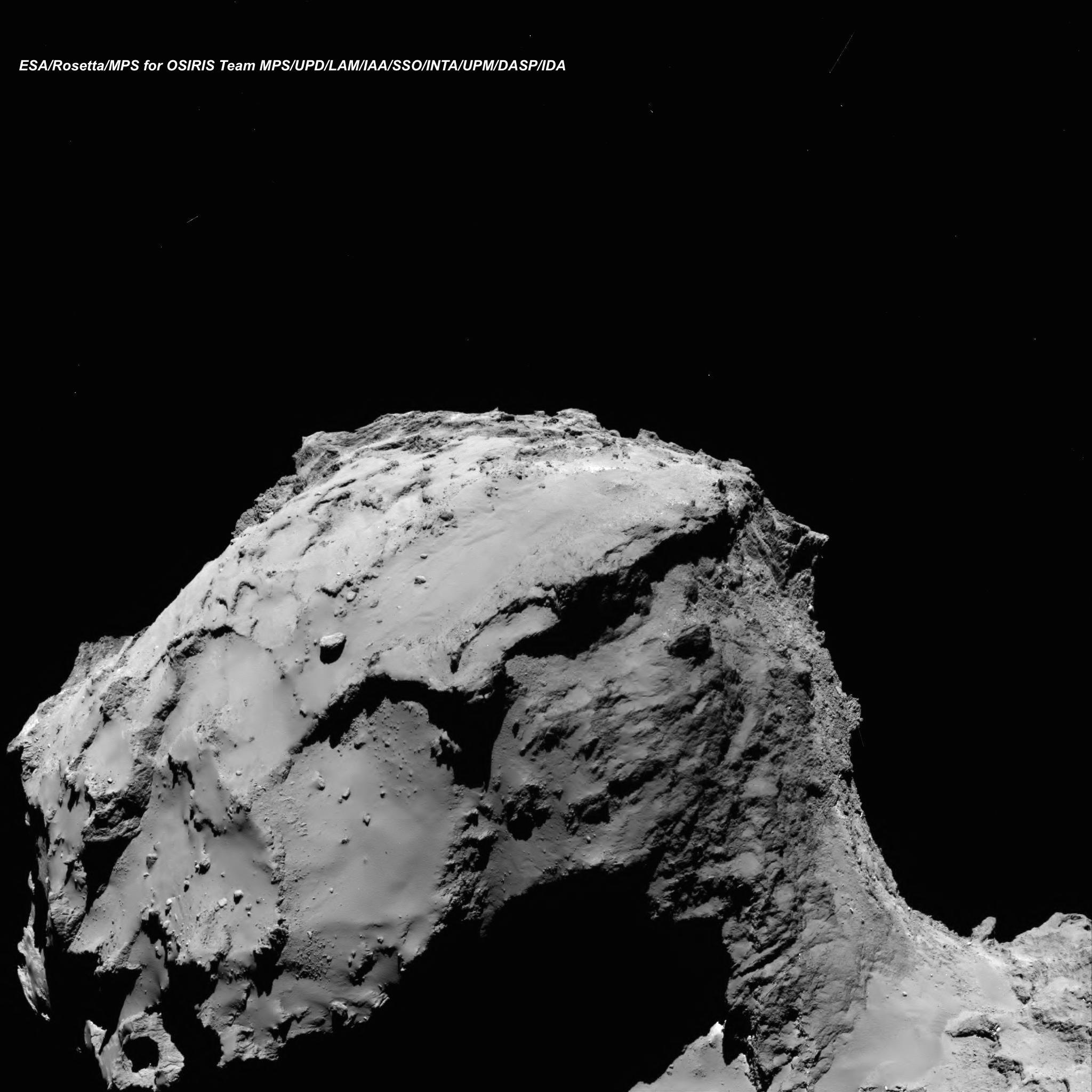
https://www.cieletespace.fr/actualites/dernieres-images-de-r...
https://twitter.com/C_et_E_Photos/status/781809777370423296
https://twitter.com/ESA_Rosetta/status/781808178048696321
https://twitter.com/elakdawalla/status/781809255443673088
https://twitter.com/C_et_E_Photos/status/781819361241817088
https://twitter.com/ESA_Rosetta/status/781825922647355392
https://twitter.com/elakdawalla/status/781834822583017472