I'm much less optimistic. Even when factoring in the poor thermal efficiency of gas turbines (~30-40%) compared to electric (>90%), the usable specific energy gap remains immense. Jet-A still delivers roughly 14 times more useful work per kilogram than modern batteries. Removing fuel plumbing and tweaking airframes won't overcome that fundamental physics. Also the issue with the high-altitude efficiency argument is that batteries, unlike liquid fuel, don't lose mass during flight meaning the aircraft to haul its maximum takeoff weight from departure to arrival. It's a double whammy.
Well, in this case, we don’t need to argue about theory. The Joby has a tested range of 150 miles. They also tested it with hydrogen fuel cells and got >500.
Right, so when you factor in the legally required reserve flight time the battery powered Joby is only capable of very short hops. And that's fine, it's still potentially useful on a few routes and newer models will improve over time.
This isn’t meant to slot into the role of other planes, though, it’s meant for rideshare. It can take off and land on my suburban lawn. There’s a lot to figure out before we can get to that point, so they’re just displace helicopters for the moment, but it can be a lot more. It’s basically the long awaited flying car, in nascent form.
No, it can't take off and land on your suburban lawn. The wires and trees overhead would make that ridiculously dangerous, a last resort only for emergencies. Plus they need to recharge for the next flight. These e-VTOL aircraft will operate from dedicated pads.
Just talking about what they've talked about as goals in interviews. And I'm surprised you're willing to make definitive statements about my lawn, we have a large enough area with none of those obstructions you're talking about, we live on a few acres. And if it's running 20 miles here and there, it can do a few trips before it needs to go somewhere to charge or battery swap. That would cover our trip to our nearest international airport.
If these e-VTOL aircraft get used for air taxi service at all it's going to be for short hops in denser urban areas. Not in rural areas where people have acres of open land.
I don't really have a problem with this - the designs look nice and don't have any of the hallmarks of AI slop. My issue is when the AI generated product is just bad, not merely the fact it was AI generated.
Nice! It would be fun to include some of the other sounds on the tube like the door closing chimes or the sounds the doors make when opening and closing.
That has not been my experience with them at all. I've done nearly quarter of a million miles in various Teslas and never had a serious issue. My service experience with them has also been lightyears ahead of the traditional manufacturers.
Nothing immediately - Teslas have a both a High Voltage system for the traction battery and a Low Voltage system powered by a separate 12-15V battery. The HV system keeps the LV system charged and most critical safety related functions run on the 12V system. The booster, ABS/ESP, airbags, and steering assist are all designed to remain functional long enough for a controlled stop after an HV disconnection.
You obviously wouldn't be able to speed up again, which depending on the situation, would be where the danger lies.
Not only is the majority of an EV the exact same components as an ICE car, but the electric car industry has been using off the shelf components for decades.
Tesla buys plenty of products from them, including things like electric steering assist.
Bosch wants to stay relevant for longer than ICE cars after all, and a lot of these components were developed for ICE cars anyway.
Tesla have done a lot of vertical integration, but for other manufacturers there's a lot of common electronic components. Stuff like headlamps (even if it's a different plastic housing the board will be the same basic design), door locks, infotainment, dashboard displays where there's little reason to significantly reengineer them for an EV.
I don't think it would have to be only electric cars, if you're building a hybrid where the 12V battery is kept charged by the high voltage battery, you've got basically the same situation.
Availability of accessories seems like it would be inconvenient for any early adopters, e.g. you can readily get USB chargers, portable generators, coolers, tire inflators, battery boosters, etc. that run off 12V... if you get a 48V vehicle today, you'd either need a 110V->12V adapter to run accessories, or you'd be limited to 48V RV accessories.
Virtually all electronics need a step down (buck) converters as they run at lower voltages 5, 3.3, 1.8. 12V > 3.3- 1V would a single step. 48V ones would likely require an intermediate step. The only exception would be running some power systems where it'd require less current.
You're going to need the expensive bits of a power supply anyway to meet transient requirements, so it's not much of a savings to run at native voltage and it gives a lot of design freedom/reusability to have one voltage for everything.
The main savings is current though, because the wiring harness is one of the most expensive parts of a car.
The move to 48v is very much about efficiency within the harness backbone. For the same wattage, less amperage is needed in a higher voltage system, meaning the wires can be smaller and they produce less waste heat.
There are a few different topologies for a 48v harness, but somewhere in the line there's a 12V DC/DC converter in there somewhere.
The wiring for 48V can be a lot thinner than it is for 12V. As there is a square law involved for resistive heating it turns out that wiring for 48V can use 1/16th of the weight of copper as that for 12V.
A switchmode converter can be designed for 48V just as easily as 12V.
It's far cheaper and easier to just pluck a readily available 12V power supply off the shelf than it is to design one that will have limited applications outside of a single manufacturer.
Because all of the IC's that are attached to the battery are designed for 12V. Things like solid state relays (BTS7008 for exammple) and the 5/3.3 volt regulators.
Ok? So you've never lived anywhere that isn't relatively central and walkable. Many people do (even in Europe!). I am one of them. And on a night when I am working late being able to order a hot pizza to my front door is a godsend.
So you do understand food delivery. Is it a stretch then to imagine why a service that expands the delivery market from a handful of pizza and chinese restaurants to ~every restaurant in the city (that wants to opt in without hiring its own fleet of drivers) is successful?
Yes. The quality of a delivered pizza is higher than the quality of other delivered foods relative to the quality of getting them for dine in at the restaurant.
I live in NYC and 9 out of 10 meals I have delivered are hot, fresh and show up on a bicycle in about 25 minutes. I know that not the norm, but a good 20-30 million Americans live in areas with an astounding number of fast and diverse delivery options and it should confuse no one as to why people take great advantage of it.
And those same urban-dwellers are far less likely to own a car, and far more likely to have a tiny kitchen.
Reminds me of the fact that for 500 years everyone graduating with a BA from Oxford had to swear that they would never agree to the reconciliation of Henry Symeonis, despite no one having any idea who he was for most of that time.
Yes! I was disappointed to learn when I graduated with my BA that this oath was no longer required. However, I continue refuse to reconcile with Henry Symeonis. It's only been 800 years, you never know when it might be important. After all, the Anglo-Portuguese is still in force 650 years on!
Looks like it was removed in 1827. I don't actually remember having to say anything at any of my graduation ceremonies there (BA, MA, DPhil), just walking on to the stage. I do wonder if at matriculation we all had to make some oath together but I think I would have remembered if that had been the case. I have a strong feeling though I might have had to make an oath when I became a scholar - there was definitely a ceremony we had to go to - but that would have been college-dependent.
You'll have collectively said "do fidem". The rest is read by the official at the table, not the graduands.
The question as to whether this constitutes swearing an oath or making a simple promise was an interesting one for me as Quakers traditionally refuse to do the former.
"i give my trust". i believe that would be a promise or affirmation as it does not invoke a god. Unless it's the accusative of the goddess of faith (unlikely).
I was reading some stories and notes made by my grandfather, they where written sometime in the 1980s. He's recalling stories and people in the area where we lived, out in the country side. Apparently my family has feud with a priest from the late 1700 hundreds. The priest complained that people (my family included) wouldn't travel the 7 - 8 kilometers to the church during the fall and winter. The area is in between would flood and freeze, becoming dangerous to travel. The priests refusal to understand the danger (and long travel time, during the winter), caused the feud, which apparently lasted at least until the 1920s.
Had to look this one up. Apparently the answer is he was a rich *hole who murdered a student, got fined £80 (which might have been a lot of money, but he was rich), stayed away from Oxford a few years and then The Powers That Be told everyone to get over it.
The fine was against multiple men. That makes me speculate the death was part of a drunkin bar fight and the victim was comnected but the King was neutral and only banned him until the King returned. Ahew, what a nest of rabbit holes to follow.
Thanks for that, looked it up and was a interesting rabbit hole:
Basically, that oath was Oxford University saying "fuck you" to a request of the King (1200s England) officially after he effectively tried to order them to break their collective line and accept a rich fuck who murdered a scholar in the past. Feels kinda like a proto-union-action to me
https://blogs.bodleian.ox.ac.uk/archivesandmanuscripts/2023/...
Which reminds me of The Cagots were a persecuted minority who lived in the west of France and northern Spain [0]
  The origins of the Cagots remain uncertain . . . . Despite the varied and
  often mythical explanations for their origins, the only consistent aspect of
  the Cagots was their societal exclusion and the lack of any distinct physical
  or cultural traits differentiating them from the general population.
The man cannot be living, ergo there can be no reconciliation, ergo the promise/oath can only exist because nobody bothers to remove it; not because we don’t know the reasons for its existence.
I'm not really surprised by this finding. My anecdotal experience has been that pretty much everyone knows a friend or a friend of a friend who smoked too much pot and had their life go off the rails. It is pretty clear to me that it is not a harmless herb despite that being the commonly held belief on places like Reddit.
Implying causality there is often misplaced. I’ve noticed some people smoke more after things start to fall apart from issues they have no control over, just as others binge eat when stressed.
It’s not a helpful coping mechanism, but there’s a reason double blind studies are considered so important. Untangling complex mechanisms especially when they have feedback in both directions is inherently difficult.
Some drunks drink more as they approach bottom. Is it the booze? Is it being the sort of person who becomes a drunk? Does it matter? More booze ain't helping.
You're really going to call for a double blind study here checking if excessive cannabis is bad for people conditional on their lives falling apart? How do you propose to get that past an ethics board?
It doesn't matter because you can't do a double blind study on pot. Double blind -> the patient doesn't know what they got. "Hmm did I get cannabis or oregano? I just can't tell". :)
You can still do a randomized trial and that's the one that wouldn't pass the IRB.
It's a great question. You can get high CBD strains now (it's getting dubbed "type 3") and you get the body relaxation and calming effects but none of the mental impact.
There aren't many studies on what are the real impacts of CBD.
Anecdatum: I personally know a mother who has a restraining order on her son, whom I also personally know, due to a psychotic episode. And the son's been smoking way too much weed for a long time. Heartbreaking.
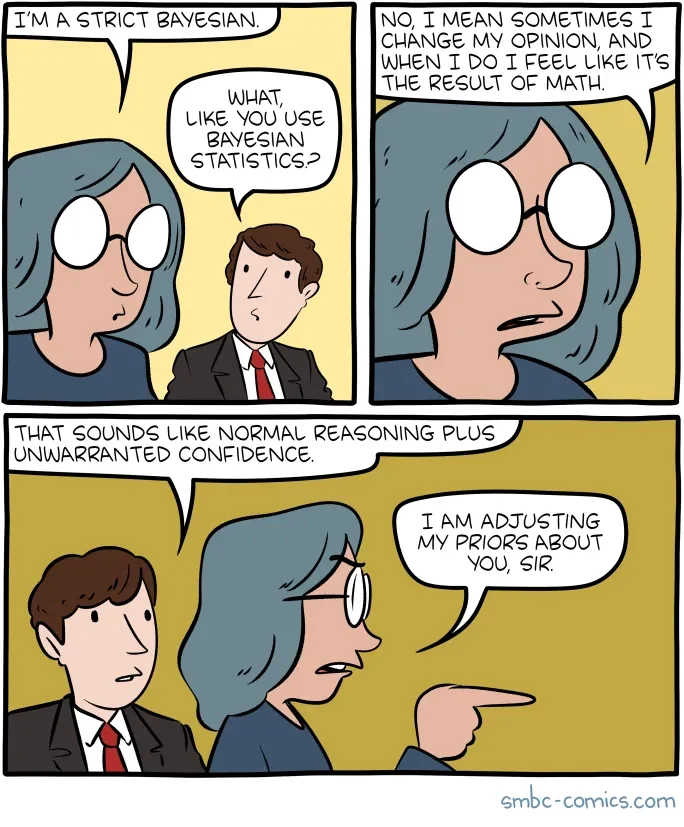
My Bayesian prior has been sufficiently updated to effectively know: I don't know a single mother with a restraining order for a son who doesn't smoke too much weed. I have met a bunch of mothers and sons in my life.
In a Popperian sense we can all only assume so stop splitting hairs.
Clearly, smoking a shit ton is bad for people with marginal mental health or marginal emotional health.
According to Scott Alexander, I only hate the grey tribe outgroup ergo with enough e-risk paperclip minimization, we can drop p(doom) with lowered replacement fertility levels via lethargy from cannabis consumption, meaning marijuana is a hedon machine and positively utilitarian. Legalizing marijuana is effectively altruistic.
Couching it in pseudo-scientific babble doesn't change the fact that it's an isolated data point, and you're vying for the olympic goal for jumping to conclusions.
> Some drunks drink more as they approach bottom. Is it the booze? Is it being the sort of person who becomes a drunk? Does it matter? More booze ain't helping.
I mean, it kind of does. If you want to design intervention, it helps to know which causes the other to a greater degree.
If it's severe enough, quitting alcohol cold turkey can be life-threatening. And for some, they don't take longer than a day from drinking to realize they're on the path to delirium tremens.
But, should we (the gov) spend 10 million dollars on social services to prevent people's lives from going to hell, should we spend 10 million dollars on anti-alcohol addiction services or should we spend it half and half, are questions we as a society need answers to.
> My anecdotal experience has been that pretty much everyone knows a friend or a friend of a friend who smoked too much pot and had their life go off the rails
Sadly, I’m seeing a new trend of people taking too many psychedelics and going off the rails.
The way they’re being pushed as cure-alls for depression is getting scary.
One of my friends developed severe problems after following the microdosing trend. It developed slowly over a long period of time, but he thought he was okay because he was following one of those protocols from one of the biggest microdosing experts.
Syd Barrett and Peter Green always come to mind, as well as some local examples who wander the streets aimlessly. The appeal of psychedelics for depression –Or rather, what I thought was depression– tempted a younger me, until I observed that the people I knew who swore by it were quite strange and not exactly exemplars of good mental health.
Pot is one of those things that makes things worse if they're already going badly.
Like alcohol or opiates will make your good life bad if you fuck too hard with them.
Pot, in my experience, won't really ruin your life unless you're already on that path.
My thing is that it's mostly harmless, but the problem with it is that young people can become complacent with it. It won't necessarily ruin your life, but you'll be content to sit and veg your life away. So not bad, but not good.
Drinking too much coffee or even water can kill you. Too much sugar can kill you (albeit not too quickly). Obsessive eating or shopping can derail your life pretty quickly. Obsessive use of social media can induce depression. Some people kill themselves because of what they read or see in social media.
So it's not the legalization at fault, it's people who are overdosing any stuff that's available to them. Casual smoking a weed once a week won't harm you that much.
While I also have anecdotal experience that suggests early-life cannabis abuse can lead to short-term memory loss, I have not seen any evidence that it leads to much else. I would imagine that people with a genetic predisposition to schizophrenia would only not have it by chance, and that altering their brain with pretty much anything can risk upsetting that balance. Doesn't matter if it's weed, LSD, opioids... SSRIs, stimulants...
> that altering their brain with pretty much anything can risk upsetting that balance. Doesn't matter if it's weed, LSD, opioids... SSRIs, stimulants...
Of course it matters. Different drugs and doses have completely different effects on the brain.
Trying to to equate different drugs and claim they’re all similarly risky goes completely against everything we know.
Conspiracy theories. Every heavy pot smoker I know has ended up believing in multiple conspiracy theories. Back in the day before YouTube my friends were burning DVDs of 9-11 Truther documentaries, a chick I dated became obsessed with UFOs and alien abductions, a close family member began to believe they had found a way to develop psychic powers, and the boomers who got their medical marijuana cards deserve their own category based on the number of right wing conspiracy theories they repost on Facebook. The only exception I can think of got heavily into sports betting with a similar level of obsession and belief that they had deep insights that escaped everyone else.
I suspect that it triggers part of your brain that rewards you for making connections or something like that.
This is definitely not the case. Half these people had no connection whatsoever to “cultural doctrine” and a number were extremely conservative and completely mainstream before they started smoking late in life. As I mentioned one takes this same attitude to sports betting, another family member is always passing me some highly unconventional investment tip he’s just learned about from some random guy.
I’ve seen this pattern emerge time and again over decades in people with completely different backgrounds. It expresses itself in different ways but smoking absolutely rewires your brain, makes you more receptive to “secret insider information”.
It puts the brain in our "art enjoyment mode" which also means lowered epistemological immune system. Cannabis should be used occasionally to play outside, make music, watch movies, etc. Not used daily when thinking about politics or stock trading :-/
From one of the papers: “the Aberrant Salience (AS) construct […] refers to an excess of attribution of meaning to stimuli that are otherwise regarded as neutral, thereby transform them into adverse, dangerous, or mysterious entities. This leads the patient to engage in aberrant and consequently incorrect interpretative efforts concerning the normal perception of reality and its relationship with our analytical abilities. AS appears to play a significant role in the onset and perpetuation of psychotic disorders. The internal conflict arising from aberrant attributions of significance leads to delusional thoughts, ultimately culminating in the establishment of a self-sustaining psychosis.” — https://www.frontiersin.org/articles/10.3389/fpsyt.2023.1343...


reply